


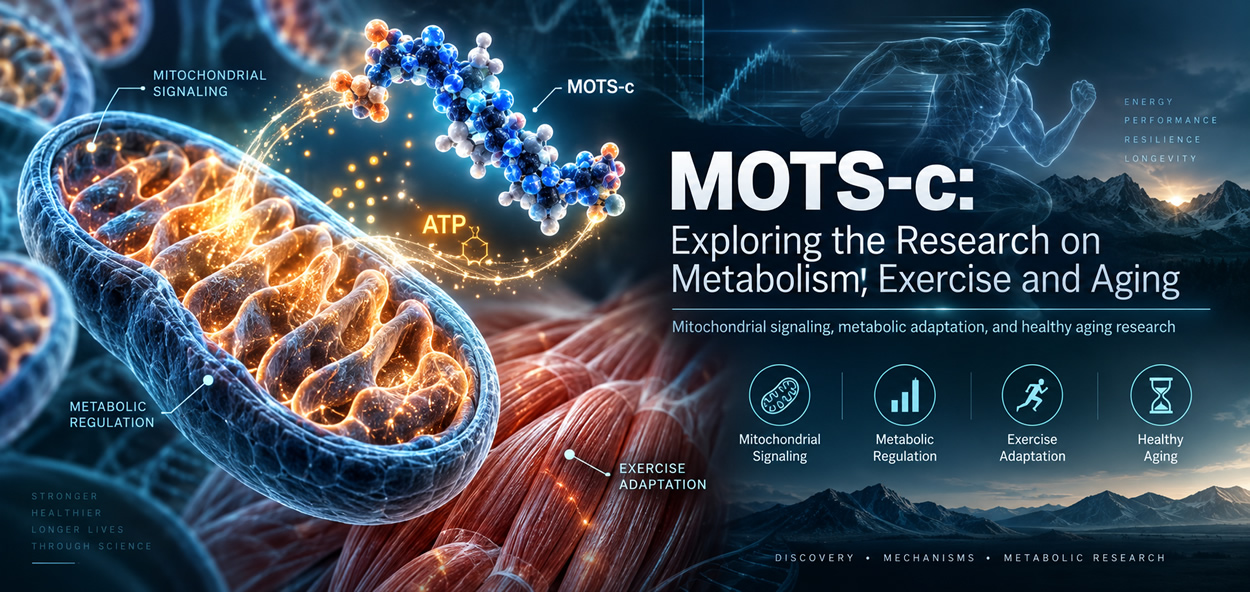
MOTS-c is a 16-amino-acid peptide encoded within mitochondrial DNA. Researchers are studying this unusual signaling molecule for its potential role in metabolism, insulin sensitivity, exercise response, skeletal muscle function, cellular stress, and age-related changes in physical capacity.
Most peptides and proteins discussed in human biology ultimately trace their instructions to DNA in the cell nucleus. MOTS-c is different. It belongs to a group known as mitochondrial-derived peptides, which originate from small genetic sequences within the mitochondria themselves.
That distinction has made MOTS-c particularly interesting to researchers studying how mitochondria communicate with the rest of the cell and how those signals may change with exercise, metabolic stress, and aging.
What Is MOTS-c?
MOTS-c, short for mitochondrial open reading frame of the 12S rRNA type-c, was first described in 2015. It is produced from a small open reading frame within mitochondrial DNA and appears to act as a signaling molecule rather than simply participating in energy production inside the mitochondria.
Research suggests that MOTS-c can influence metabolic pathways elsewhere in the cell and, under certain types of cellular stress, can move into the nucleus and affect gene expression. This has contributed to a broader view of mitochondria as signaling centers that communicate with the nucleus rather than functioning only as the cell's energy-producing structures.
How Does MOTS-c Work?
One of the pathways most closely associated with MOTS-c research is AMP-activated protein kinase (AMPK). AMPK acts as a cellular energy sensor, responding when cells experience changes in energy availability.
Activation of this pathway is associated with changes in glucose uptake, fat metabolism, mitochondrial activity, and the way cells adapt to energetic stress. Exercise also influences AMPK signaling, which is one reason researchers have become interested in the relationship between MOTS-c and physical activity.
MOTS-c research also suggests communication between the mitochondrial and nuclear genomes. Experimental studies have found that MOTS-c can enter the nucleus during metabolic stress and influence genes involved in stress adaptation and metabolism.
What Has MOTS-c Research Studied?
Research on MOTS-c spans several connected areas:
- Glucose metabolism and insulin sensitivity
- Skeletal muscle metabolism
- Exercise response and physical capacity
- Metabolic flexibility
- Cellular stress responses
- Age-related physical decline
- Inflammatory signaling
The strength of evidence is not equal across these areas. Some of the most striking findings involving administered MOTS-c come from animal experiments, while human research has largely examined naturally produced MOTS-c and its relationship with exercise, metabolism, or physical characteristics.
MOTS-c and Metabolic Research
The original research describing MOTS-c found that it influenced metabolic homeostasis and insulin sensitivity in experimental models. In mice, administered MOTS-c improved insulin sensitivity and reduced metabolic changes associated with a high-fat diet.
Researchers linked part of this effect to AMPK signaling and changes in cellular metabolism. These findings helped establish MOTS-c as a mitochondrial signaling peptide of interest rather than simply another small product of mitochondrial DNA.
These results are important mechanistically, but they should not be treated as proof that administered MOTS-c produces the same metabolic effects in humans. Much of the intervention evidence in this area remains preclinical.
MOTS-c and Exercise
Exercise research provides one of the more interesting connections between MOTS-c biology and humans.
In a 2021 study, researchers measured MOTS-c in healthy young men before and after cycling exercise. Endogenous MOTS-c increased substantially in skeletal muscle after exercise, while circulating levels also rose during and shortly after exercise.
This suggests that the body may naturally alter MOTS-c signaling in response to physical activity.
Separate human research has also examined circulating mitochondrial-derived peptides following resistance and endurance exercise, adding to evidence that these peptides respond dynamically to physical stress.
However, there is an important distinction: showing that the human body naturally changes MOTS-c levels during exercise is not the same as showing that administering MOTS-c reproduces the benefits of exercise in people.
Research on Physical Capacity and Muscle Function
Some of the strongest experimental findings involving administered MOTS-c come from animal studies.
Researchers have reported improvements in treadmill performance and metabolic function in young, middle-aged, and older mice given MOTS-c. In older mice, experimental treatment was associated with improvements in measures of physical capacity and metabolic flexibility.
Late-life experiments also examined grip strength, gait, walking capacity, body composition, and other measures related to healthspan. These studies produced intriguing results, but they remain animal experiments and cannot establish the same effects in humans.
MOTS-c and Aging Research
Mitochondrial function changes with age, making mitochondrial signaling molecules an active area of aging research. MOTS-c has attracted attention because its expression appears to be age-dependent and because experimental studies connect it with metabolic adaptation and physical function.
In older mice, late-life MOTS-c administration improved several measures of physical capacity. Researchers also observed a trend toward longer median and maximum lifespan, but the study authors noted that larger experiments would be needed to determine whether the apparent longevity effect was meaningful.
That distinction matters. The evidence is stronger for effects on physical function in these animal models than it is for a direct lifespan-extending effect.
What Does the Human Research Actually Show?
The human evidence for MOTS-c is considerably more limited than the animal literature.
Human studies have primarily examined endogenous MOTS-c — the peptide naturally produced by the body — rather than administering MOTS-c as an experimental intervention.
Researchers have studied associations between MOTS-c and areas such as:
- Acute responses to exercise
- Skeletal muscle biology
- Metabolic health
- Age-related changes
- Physical function
- Various chronic health conditions
These studies can help researchers understand what MOTS-c may be doing naturally, but observational relationships do not prove that changing MOTS-c levels will cause a particular health outcome.
This is currently one of the most important limitations in interpreting MOTS-c research.
Is MOTS-c Really an “Exercise Mimetic”?
MOTS-c is sometimes described as an exercise mimetic because experimental research shows overlap between some of its metabolic effects and pathways activated by exercise.
That term can easily be misunderstood.
Research does not establish MOTS-c as a replacement for exercise. Instead, researchers are investigating whether it participates in some of the molecular signaling involved in the body's adaptation to physical activity.
The finding that exercise itself increases endogenous MOTS-c in humans may actually be one of the more interesting parts of the story: MOTS-c could be one component of the biological network through which skeletal muscle and mitochondria respond to exercise.
What Has Safety Research Reported?
Safety information for administered MOTS-c in humans remains limited because large controlled human intervention studies have not established a comprehensive safety profile.
Animal studies have provided useful early information, but animal tolerability cannot establish human safety. Researchers also do not yet have the kind of long-term human data needed to understand how sustained alteration of MOTS-c signaling might affect interconnected metabolic systems.
Studies showing that natural MOTS-c levels differ among people with certain health conditions should also be interpreted carefully. An association between MOTS-c levels and a disease or metabolic state does not establish whether MOTS-c contributed to the condition, resulted from it, or simply changed alongside other biological processes.
Why Is MOTS-c of Research Interest?
MOTS-c is notable not simply because of one proposed effect, but because of where it comes from.
Its discovery helped strengthen evidence that mitochondrial DNA can encode biologically active signaling peptides capable of influencing processes beyond the mitochondria themselves. Research on MOTS-c therefore sits at the intersection of mitochondrial biology, metabolism, exercise physiology, cellular stress, and aging.
The preclinical findings involving metabolic function and physical capacity are substantial enough to justify continued investigation. At the same time, the human evidence remains much less developed than the animal research, particularly when it comes to administering MOTS-c directly.
For now, MOTS-c is best understood as an emerging mitochondrial signaling peptide with an interesting biological foundation and a growing research record, but with important questions about its effects and safety in humans still unresolved.
Research Sources
MOTS-c research includes the original 2015 work identifying its metabolic functions, laboratory studies examining AMPK signaling and mitochondrial-to-nuclear communication, animal studies investigating insulin sensitivity, exercise capacity and age-related physical decline, and human studies measuring naturally occurring MOTS-c during exercise and in different metabolic or physical states.
Published research includes work in journals such as Cell Metabolism, Nature Communications, and other peer-reviewed physiology and metabolism publications. The evidence base currently combines mechanistic laboratory research, extensive animal work, and a smaller body of human observational and exercise research.